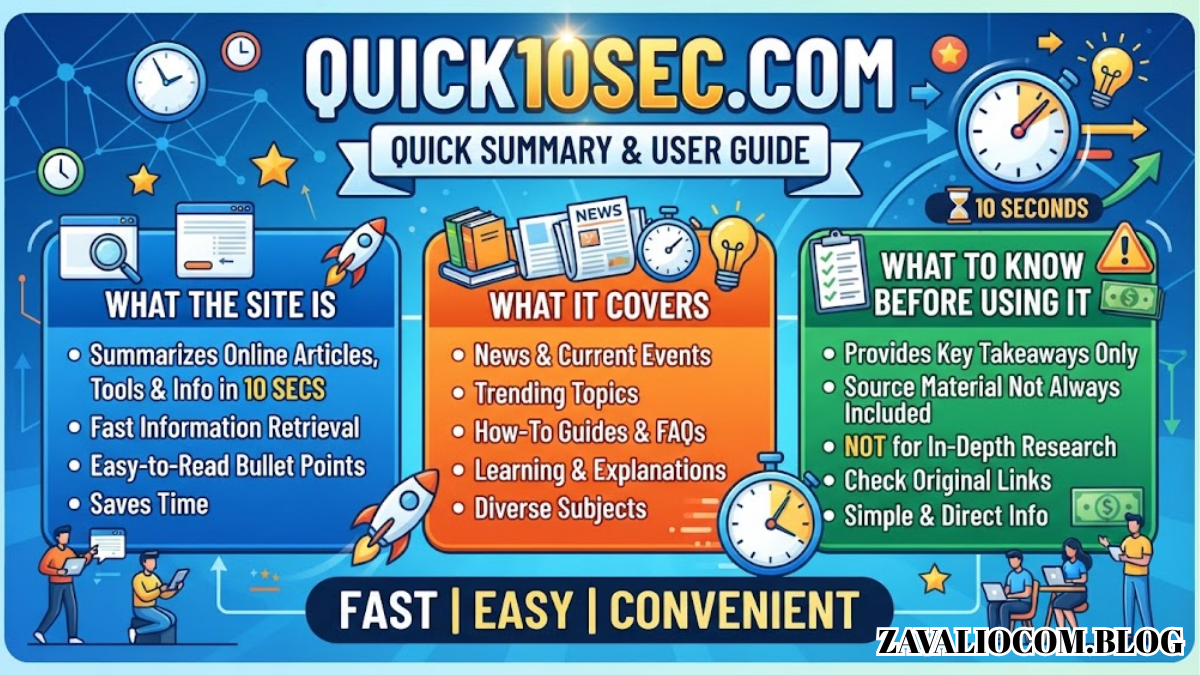
Quick10sec Com: What the Site Is, What It Covers, and What to Know Before Using It
Search for an unfamiliar website by name and you usually want one of three things: a quick explanation of what it does, reassurance that you have the right site, or some idea of whether the information there is worth trusting.
That is exactly the situation surrounding quick10sec com. The domain has been appearing more often in searches connected with technology, business, digital tools, and general online trends, yet it is still far less recognizable than established publishers such as CNET, Wired, or PCMag.
Public domain data shows that Quick10sec.com was registered on March 18, 2023, while currently indexed metadata describes it as a digital platform focused on technology, business, and online trends. That gives us a much more useful starting point than some of the vague descriptions circulating online.
So what should an American reader actually expect from the site, how should its content be evaluated, and is it something you can safely use as an information source? Here is the practical breakdown.
What is Quick10sec.com actually supposed to be?
The simplest description is a general informational website with an emphasis on digital subjects.
According to publicly visible site metadata, the platform positions itself around fast informational updates involving technology, business, and online digital trends. Other recent descriptions of the site also associate it with software, gadgets, digital tools, internet trends, productivity, and related topics.
That places it in a familiar category of web publishing: not a single-purpose application, store, bank, or software service, but a content site covering several subjects that overlap with modern online life.
The name can cause some confusion. “10sec” sounds like it might refer to a timer, instant-download service, speed test, or ten-second video platform. Based on the information publicly associated with the actual domain, however, it is better understood as branding built around quick access to information rather than a literal ten-second tool.
That distinction matters. A reader searching for a countdown timer, for example, probably has the wrong search intent. Someone trying to understand a new app, online business topic, or digital trend is much closer to the site’s apparent purpose.
Why are people suddenly searching for it?
Lesser-known websites often produce branded searches after readers encounter them somewhere else.
You might see a site mentioned in Google results, discover an article through a link, notice the domain in a referral report, or find someone discussing it on another website. Instead of blindly clicking around, many people then search the domain name separately.
That’s a sensible habit.
Recent web results show multiple independent articles attempting to explain or review the platform, particularly during 2026. That does not automatically prove popularity or authority, but it does explain why the name is surfacing more frequently in search.
There is another factor at work: general technology publishing has become extremely fragmented. Readers no longer reach information only through five or six massive publishers. Thousands of smaller websites now cover AI tools, apps, cybersecurity, software updates, online business, gaming, productivity, and internet culture.
A niche article can rank for one specific question even if most readers have never heard of the website publishing it.
What type of content should you expect?
The available descriptions consistently point toward technology and broader digital information rather than one narrow specialty. Public summaries associate the site with topics such as software, gadgets, internet resources, business, online trends, and technology news.
That kind of broad editorial scope can be useful for casual research.
Suppose you see a new AI productivity tool mentioned on TikTok and want a five-minute explanation before signing up. A general technology article may give you enough background to understand what the product does. The same applies if you’re researching an unfamiliar website, reading about a software feature, or trying to understand some new digital term that has started appearing in search.
The limitation is authority.
For a simple explainer, a smaller publication may be perfectly useful. For a security vulnerability affecting your Windows PC, an investment decision involving $5,000, or advice about protecting company data, I’d want stronger primary sources.
That’s where most guides about unfamiliar websites get this wrong: they treat credibility as a yes-or-no question.
It isn’t.
A website can publish a perfectly useful explanation of a browser feature without being the source you should rely on for financial, medical, legal, or cybersecurity decisions.
Is Quick10sec Com legit or safe?
There isn’t enough publicly verified information to responsibly slap either a “100% safe” or “scam” label on the site.
The domain itself is not brand new. Public WHOIS-derived data shows a creation date of March 18, 2023, with the listed registration extending through March 18, 2034. Domain age alone does not prove legitimacy, but a multi-year registration history is more informative than dealing with a domain created last Tuesday.
At the same time, publicly available company information appears limited. One recent independent review specifically noted that transparency around the organization behind the site was limited.
That means normal web-safety habits still apply.
Before giving any unfamiliar site personal information, I check whether the connection uses HTTPS, whether the page clearly explains what information is being collected, whether there are working contact and privacy pages, and whether the action I’m being asked to take makes sense.
Reading a public article involves very little risk. Uploading your driver’s license, entering a credit card, installing an executable file, or reusing your Gmail password is an entirely different decision.
If a random page ever asks you to disable antivirus protection, install an unknown browser extension, send cryptocurrency, provide a one-time banking code, or download a mysterious .exe file, leave. That advice applies to every unfamiliar website, not only this one.
How I evaluate information from smaller tech websites
I don’t automatically dismiss smaller publishers. Some of the best explanations on the web come from specialists running websites most people have never heard of.
I also don’t trust an article simply because it ranks first on Google.
For technology content, the fastest credibility test is to look at the details. Does the article name the exact software version? Does it link or refer to the original developer? Does a tutorial show settings that actually exist? Are dates provided where dates matter?
Imagine an article saying, “Windows has recently changed its security settings.” That statement is almost useless.
A stronger article would identify Windows 11, the relevant feature, the update or build involved, and the steps needed to verify the setting on your own PC.
Specificity is hard to fake consistently.
Dates deserve particular attention with AI and software coverage. An excellent ChatGPT tutorial from 2023 can be badly outdated in 2026 because interfaces, model availability, pricing, and product names change quickly. The same problem affects iPhone features, Android menus, social platforms, SEO tools, and cloud software.
Use an article as a starting point, then verify anything consequential.
Don’t confuse readable content with primary-source information
A well-written article can explain something better than the original documentation. That still doesn’t make it the original source.
Say you’re researching a new Google Search feature. A general technology website might explain it in plain English far better than a technical announcement. That’s useful.
But if you need to know exactly when the feature launched in the United States or which accounts qualify, Google’s own documentation should settle the question.
The same hierarchy works elsewhere:
For Microsoft products, check Microsoft.
For an IRS rule, check IRS.gov.
For Apple device specifications, check Apple.
For SEC filings, check SEC.gov.
For software pricing, check the software company’s current pricing page.
I use independent articles to understand a subject and primary sources to verify high-stakes details. That one habit eliminates a surprising amount of bad online research.
Why the site’s speed-focused branding makes sense
The “quick” concept fits how people consume information now, even if the name isn’t describing a literal ten-second service.
Google users increasingly search for specific answers rather than browsing publications from the homepage. Someone may search “what does passkey mean,” read one article, get the answer, and leave three minutes later.
That behavior rewards clarity.
A technology article does not need a 600-word history lesson before explaining how to turn off a setting. If the answer takes 20 seconds to explain, tell me in 20 seconds. If the subject genuinely requires 1,500 words, give me the 1,500 words.
Short is not automatically better. Fast access to the useful part is.
What I’d check before relying on an article there
Start with the publication date, especially for technology. Then see whether the author distinguishes facts from predictions or opinions.
Look for specific names, figures, software versions, and references that you can independently verify.
For example, an article claiming a tool costs “$10 per month” should make you suspicious if the company’s own pricing page now says $19.99. The article may not be dishonest; it may simply be outdated.
I would also search one or two distinctive claims separately. You don’t need a full investigative report for every blog post. Thirty seconds of cross-checking is often enough to tell whether an article is grounded in real information or just repeating vague statements from other sites.
What the site is probably best used for
Based on its apparent editorial focus, the strongest use case is discovery and general understanding.
You find a term you haven’t seen before. Read an overview.
You hear about an emerging digital trend. Get some background.
You want a simple explanation before reading dense official documentation. Use an independent article to establish context.
That is different from treating every page as definitive evidence.
Readers who understand that difference can get plenty of value from smaller informational websites without becoming overly trusting of them.
FAQs
Is quick10sec.com a real website?
Yes. Public domain records show that the domain was registered on March 18, 2023, and currently points to a website identifying itself as an informational digital platform. Its public metadata emphasizes technology, business, and online trends.
What does Quick10sec publish?
Available descriptions indicate that it publishes general digital and technology-focused information, including material involving software, online tools, gadgets, business, and internet trends. The exact mix of topics can change as new articles are added.
Is Quick10sec a ten-second timer?
No evidence suggests that the main website is primarily a ten-second countdown timer. The “10sec” wording appears to function as speed-oriented branding for quick information rather than describing a literal timer service.
Can I trust articles from the site?
Use them for general research, but verify important claims with primary sources. That is especially important for money, cybersecurity, software pricing, privacy, health, legal issues, or anything requiring current official information.
Why can’t I open Quick10sec sometimes?
Temporary access issues can have many causes, including server configuration, security rules, regional filtering, CDN behavior, maintenance, or browser/network problems. During current research, an automated request to the site’s homepage returned a 403 response, so access may differ depending on how the site is reached.
Quick10sec is best approached for what it appears to be: a smaller general-information publisher covering technology and digital subjects. Read it when an article answers the question you searched for, but keep the same standard you’d use anywhere else online—check dates, look for specifics, and verify important claims at the original source.