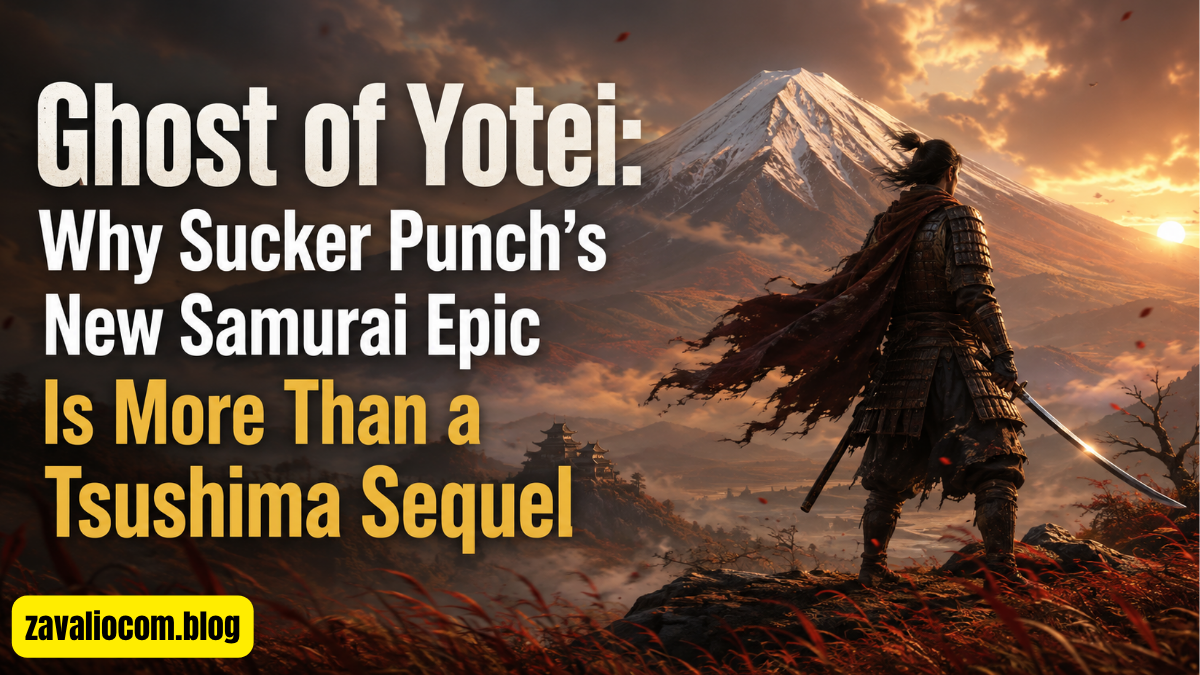
Ghost of Yotei: Why Sucker Punch’s New Samurai Epic Is More Than a Tsushima Sequel
Few PlayStation games had a tougher act to follow than Ghost of Tsushima. Sucker Punch’s 2020 open-world hit built its reputation on razor-sharp sword fighting, cinematic landscapes, and an unusually clean approach to exploration. Ghost of Yotei could have simply repeated that formula with a larger map and prettier graphics.
Instead, it moves the story more than 300 years forward, replaces Jin Sakai with a new protagonist, shifts the action to northern Japan, and makes weapon choice a much bigger part of combat. The result is a standalone PS5 adventure that feels familiar without functioning like Ghost of Tsushima 2.
The game launched for PlayStation 5 on October 2, 2025. Since then, Sucker Punch has added New Game+, released the free Legends multiplayer mode, and announced an expanded Complete Edition for October 1, 2026 in the United States.
What is Ghost of Yotei actually about?
The story takes place in 1603 around Mount Yōtei in Ezo, the region now known as Hokkaido. That date matters because it places the game in a completely different era from Jin Sakai’s 13th-century fight against the Mongol invasion.
You play as Atsu, a wandering mercenary driven by revenge against six people responsible for destroying her family. Those targets—the Snake, Kitsune, Oni, Spider, Dragon, and Lord Saitō—form the Yōtei Six. Instead of chasing one military campaign across an occupied island, Atsu travels through Ezo tracking individual enemies and the groups surrounding them.
Calling it just another revenge story undersells what Sucker Punch is trying to do. PlayStation describes Atsu’s journey as ultimately being about healing and redemption, and the game regularly pulls her away from pure vengeance through allies, travelers, camps, and memories of her past.
That gives the story more breathing room than a simple six-name kill list would suggest.
Is this really a sequel to Ghost of Tsushima?
Technically, it is better described as a standalone follow-up.
The two games share the “Ghost” identity, design philosophy, cinematic influences, and several gameplay ideas, but their central stories are separated by roughly three centuries. Jin Sakai does not appear as an active character. PlayStation explicitly confirms that the new story occurs hundreds of years after his lifetime, although his legend still has a place in the world.
That separation was a smart decision.
Trying to invent another enormous crisis for Jin immediately after Tsushima could easily have weakened his original arc. Atsu gives Sucker Punch freedom to build a different personality, historical backdrop, enemy structure, and fighting style while keeping the qualities people associate with the series.
New players also don’t need to finish Ghost of Tsushima first. You will recognize more references if you have, but the core plot does not depend on remembering Jin’s story.
The biggest improvement is the weapon system
Combat is where the sequel’s identity becomes clearest.
Jin primarily fought with his katana and changed combat stances depending on the enemy. Atsu instead develops a much broader collection of dedicated weapons. Each one has matchups where it performs particularly well.
The main arsenal includes:
- Katana for balanced sword combat and duels
- Dual katana for fast attacks against spear users
- Ōdachi for powerful strikes against heavy enemies
- Yari for reach and control against sickle-wielding opponents
- Kusarigama for crowd control and breaking shield defenses
- Shortbows and longbows
- Tanegashima matchlock firearms
- Kunai, smoke bombs, Metsubushi, and other quick-fire tools
Sucker Punch also lets Atsu disarm enemies, turn dropped weapons against them, attack from horseback, and call on her wolf companion during certain fights.
This system makes switching equipment part of reading a battlefield rather than just something you do because a new weapon has a higher damage number.
That distinction is important. Most open-world games give players piles of weapons that eventually become inventory clutter. Here, the weapon categories are tied directly to enemy behavior.
Ezo is designed to make wandering worthwhile
One of Tsushima’s strongest ideas was removing the giant floating waypoint arrow and letting wind guide the player. The new game keeps that philosophy while giving you more ways to investigate the environment.
Atsu can use a spyglass to mark distant locations, follow wildlife toward discoveries, climb with a grappling hook, travel on horseback, and set up camp. Travelers encountered on the road can provide items, songs, trades, or information about targets. Allies can also visit Atsu’s campsite and offer upgrades.
There are plenty of recognizable open-world activities, including hot springs, bamboo strikes, shrines, Inari shrines, wolf dens, Altars of Reflection, and scenic locations where Atsu creates sumi-e paintings.
The important part is that these activities affect progression. Hot springs increase maximum health, bamboo strikes expand Spirit, shrines provide charms, and Altars of Reflection unlock techniques.
That does not magically eliminate open-world repetition, but it gives detours a purpose beyond filling a percentage meter.
How long is the game?
There is no single useful number because estimates vary dramatically depending on play style.
A highly focused run can be much shorter, while players who explore naturally can spend dozens of additional hours in Ezo. PowerPyx estimated roughly 20–30 hours for a medium-difficulty playthrough with a moderate amount of optional content and around 50–60 hours for extensive completion. Other outlets reported significantly longer times for players who regularly wandered away from the main path.
The sensible expectation is around 25–40 hours for someone primarily interested in the story but willing to explore occasionally, with 50-plus hours easily possible if you chase side content.
New Game+ extends that considerably. It carries over gear, upgrades, cosmetics, resources, and collectibles while adding Ghost Flowers, new charms, two additional upgradeable armor sets, extra weapon and armor upgrades, and replayable challenges and duels.
The presentation is still one of the main attractions
Ezo gives the art team an excuse to move beyond the golden forests and coastal fields many people remember from Tsushima. Snow-covered ridges, grasslands, forests, mountains, and changing weather give northern Japan a rougher visual personality.
The cinematic modes are even more interesting.
Kurosawa Mode returns with black-and-white visuals, film grain, altered sound, and heavier wind. Miike Mode, developed in collaboration with filmmaker Takashi Miike, moves the camera closer during combat and emphasizes mud and blood. Watanabe Mode takes inspiration from director Shinichirō Watanabe and adds original lo-fi music. Samurai Cinema Mode provides Japanese voices with lip synchronization and English subtitles.
These aren’t just novelty filters. They can noticeably change how a 40-hour game feels.
Accessibility deserves more attention than it gets
The game includes options that go well beyond subtitle size.
Players can enhance the visibility of the Guiding Wind, add a persistent center dot to reduce motion sickness, increase combat attack cues, enable projectile indicators, use aim assist, simplify button holds, remove timing pressure from rapid button sequences, and replace some DualSense motion or microphone interactions with conventional button inputs.
That last detail is particularly thoughtful. Blowing into the controller microphone to start a campfire may be immersive the first few times, but giving players an R2 alternative prevents a gimmick from becoming an accessibility barrier.
Legends gives the combat system a second life
The free Ghost of Yōtei Legends update launched on March 10, 2026 for owners of the base game.
Like the multiplayer mode from Tsushima, it abandons the grounded tone of the campaign for supernatural enemies and co-op combat. Players can choose Samurai, Archer, Mercenary, or Shinobi classes, each built around different weapons and skill trees. Survival supports teams of up to four players, while the broader mode also includes story content and additional multiplayer challenges. Online play requires PlayStation Plus.
This is more meaningful than a basic arena mode because Yōtei’s weapon specialization fits class-based multiplayer naturally.
What is coming in the Complete Edition?
The timing is worth knowing if you’re thinking about buying the game in late 2026.
Sucker Punch has announced Ghost of Yōtei Complete Edition for October 1, 2026 in the United States. Existing owners can purchase the Complete Edition Upgrade for $14.99.
The biggest addition is Echoes of Sekigahara, a narrative expansion exploring Atsu’s past on mainland Japan and her connection to the Battle of Sekigahara. It also opens a previously unseen valley in Ezo and introduces new enemies, equipment, and weapons.
The package also includes Most Wanted, a single-player survival mode with roguelike-style runs. Players accept bounties, earn temporary advantages during runs, unlock characters, and fight increasingly difficult encounters.
A free update arriving alongside it will add quality-of-life improvements, additional Watanabe Mode music, Beauty of Yōtei mode, a high-contrast accessibility option, and the ability to use one armor set’s appearance while retaining another set’s stats.
For somebody buying for the first time, that makes the Complete Edition the version to watch.
Does Ghost of Yotei live up to the hype?
Critical reception suggests that it largely did.
Metacritic currently lists an 86 Metascore, with 92% of counted critic reviews categorized as positive. Its user score sits at 8.1/10. Reviews repeatedly praised the combat, landscapes, presentation, and refinements to open-world exploration, while some criticism focused on the familiar revenge framework and the fact that the overall structure remains evolutionary rather than revolutionary.
That criticism is fair. This is not the game that reinvents open-world action.
It is the game that takes a very successful formula and removes some friction from it.
There is a difference.
Frequently Asked Questions
Is Ghost of Yotei only on PS5?
Yes. The game launched exclusively for PlayStation 5 and supports PS5 Pro enhancements. PlayStation has not announced a PC release date as of August 31, 2026.
Do I need to play Ghost of Tsushima first?
No. Atsu’s story takes place more than 300 years later and is designed as a standalone adventure. Playing Tsushima mainly gives you additional context for references to Jin Sakai and the broader Ghost legacy.
Is Jin Sakai in the new game?
Jin does not appear as the protagonist or a living character because of the centuries separating the two stories. His legend, however, has not been completely forgotten.
Does it have multiplayer?
Yes. Yōtei Legends launched in March 2026 as free DLC for game owners and includes cooperative supernatural combat with four playable classes. A PlayStation Plus subscription is required for online multiplayer.
Is the Complete Edition worth waiting for?
If you have not bought the game yet and can wait until October 1, 2026, it is the most complete package. Existing owners have a cheaper option: the announced Complete Edition Upgrade costs $14.99 and adds the new expansion and survival mode.
Sucker Punch didn’t need to reinvent its samurai formula to make this follow-up work. The better decision was expanding the parts that already mattered—exploration, duels, atmosphere, and player freedom—while giving Atsu enough new weapons and personality to escape Jin Sakai’s shadow. If Tsushima clicked for you, this is less a risky sequel than a sharper, more flexible version of the same design philosophy.