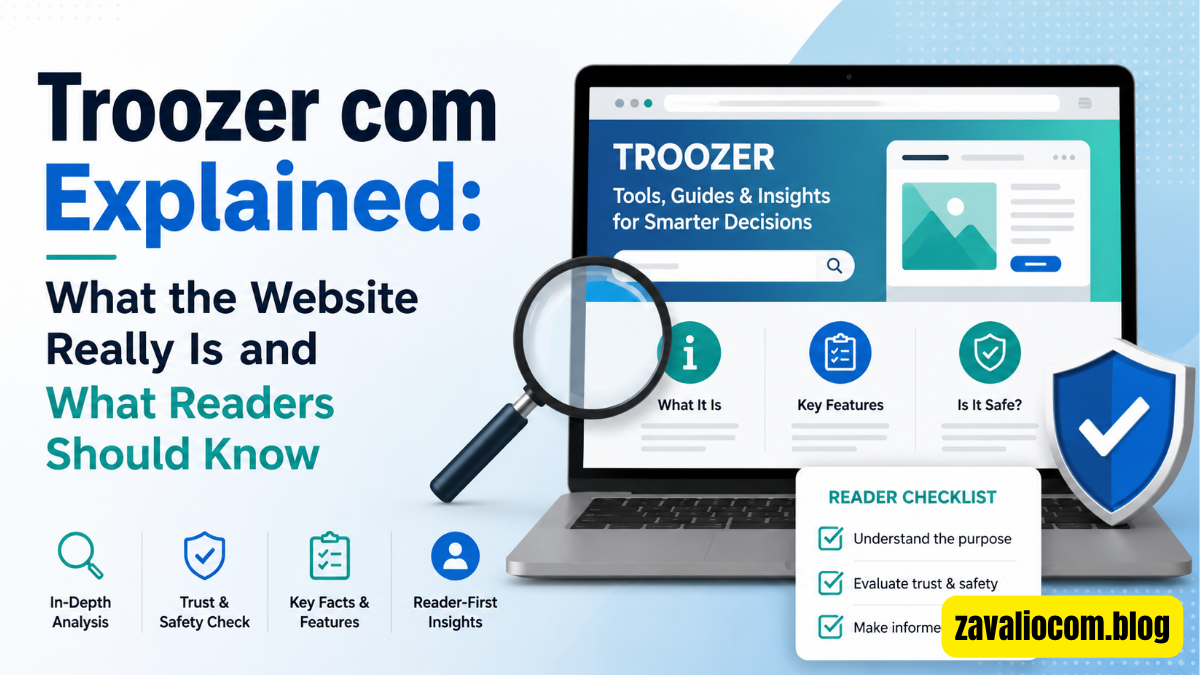
Troozer com Explained: What the Website Really Is and What Readers Should Know
A strange thing happens when you search for information about Troozer. One page describes it as an AI-powered productivity system. Another calls it a marketplace. Somewhere else, you may see references to cloud collaboration, shopping tools, project management, or digital services.
That sounds impressive—until you look at what the current website actually presents.
Based on its public-facing identity and recently indexed pages, Troozer is best understood as a multi-category digital publishing website. Its content spans technology, finance, business, health, education, lifestyle, travel, law, automotive topics, sports, and other general-interest subjects. Recent technical data also identifies the site’s page title as a multi-category digital media publishing platform.
The important question, then, isn’t just “What is this website?” It’s why so many different descriptions exist, how much you should trust its articles, and what you should check before relying on anything you read there.
What Is Troozer Actually Used For?
The site’s current structure resembles an online magazine or general information blog rather than a traditional software product.
Visitors primarily encounter articles organized into categories. Recent reviews of the live site identify sections including Technology, Business, Finance, Health, Law, Sports, Automotive, and Travel, while broader archives reportedly include areas such as education, lifestyle, food, fashion, entertainment, home improvement, and real estate.
That variety is significant.
A finance-focused publication might spend nearly all its resources covering investing, banking, credit cards, and economic news. A technology publication might concentrate on software, devices, cybersecurity, and artificial intelligence.
Troozer takes the opposite approach. It casts a much wider editorial net.
One recent analysis found homepage subjects ranging from hearing-aid doctors in Houston to artificial intelligence in business operations and passive-income strategies. That is a good example of what readers should expect: very different topics appearing under one publishing brand.
For someone casually browsing the web, that setup can be convenient. You can jump from a business article to a health guide without visiting another publication.
The tradeoff is specialization. A website publishing across ten or more major fields has a harder job demonstrating deep authority in every one of them.
Why Do Search Results Describe It So Differently?
If you search troozer com, the confusing part becomes obvious almost immediately.
Some third-party pages describe task-management features, user dashboards, automation, cloud storage, team collaboration, shopping services, or AI-powered tools. Recent examinations of the public website, however, have not found visible evidence of a traditional SaaS dashboard, project boards, cloud workspace, retail checkout system, or comparable software interface.
That difference matters because there is a huge gap between an informational publication and a software platform.
Suppose somebody tells you a website competes with productivity products such as Asana or Monday.com. You would reasonably expect account creation, workspaces, task assignments, notifications, user permissions, subscription plans, or integrations.
If those features cannot be demonstrated on the actual site, a detailed third-party feature list shouldn’t automatically be treated as fact.
My approach here is simple: judge a website by what can be observed before judging it by what other blogs claim it can do.
The most plausible explanation for much of the confusion is that inaccurate or outdated descriptions have been repeatedly republished. Once one article labels an unfamiliar domain an “AI platform,” later sites can repeat the claim without independently testing anything.
That is how online speculation starts looking like established information.
What Kind of Content Can You Find There?
The site’s biggest strength is breadth.
Technology content can touch on AI, websites, digital tools, online marketing, software, and internet trends. Business articles may discuss company operations, professional services, workplace technology, or growth strategies.
Finance material appears to cover areas such as income, financial independence, business finance, and money-related topics. Health articles have included subjects involving dental care, hearing care, testing, hospice services, and other healthcare topics.
Travel and legal material add another layer.
For a general reader, this format works best for discovery. You might find an explanation of a topic you hadn’t planned to research or get enough background information to understand what terminology to search next.
I would be more careful with high-stakes categories.
If an article discusses a $20,000 investment decision, a medical symptom that has lasted three weeks, an immigration deadline, or a legal dispute involving your home, a general publishing site should never be your only source.
Use it to understand the subject. Then verify the important parts through official agencies, licensed professionals, established medical institutions, regulatory bodies, or original documentation.
Is Troozer com Safe to Browse?
There is a difference between technical browsing safety and information reliability.
Technical domain data shows that Troozer.com supports HTTPS/SSL and currently uses Cloudflare infrastructure. Available WHOIS information also shows the domain was registered on March 15, 2013, with its current registration listed through March 2030.
Those are useful signals, but they should not be exaggerated.
HTTPS means your connection to the website can be encrypted. It does not mean every statement published on the website is correct.
Domain age works the same way. A domain that has existed for roughly 13 years may look more established than one registered yesterday, but registration age alone cannot tell you who currently operates it, how editorial standards work, or whether a particular article has been reviewed by an expert.
This is where many website-review articles go wrong. They look for SSL, see an older domain, and jump straight to “100% safe.”
Real trust doesn’t work that way.
For ordinary reading, the risk level is naturally lower because you’re mainly opening public pages. The standard precautions still apply: verify that you are on the correct domain, don’t download unexpected files, don’t provide unnecessary personal information, and treat unusually sensitive requests with skepticism.
Can You Trust the Articles?
Trust should be evaluated article by article.
A well-written piece about choosing website fonts carries very different consequences from an article giving financial, medical, or legal guidance. The higher the stakes, the stronger the sourcing should be.
Before relying heavily on a piece, I would look for a few things:
- Is a real author identified?
- Does the article cite authoritative sources?
- Is there a publication or update date?
- Are factual claims specific enough to verify?
- For health, law, or finance topics, is professional expertise clearly established?
Broad publishers can absolutely produce useful content. The problem comes when readers assume that publishing volume equals expertise.
For example, imagine an article claims a particular tax deduction will save an average American household $3,500. Rather than accepting that number because the page ranks well on Google, check the relevant IRS guidance and confirm that the rule applies to the current tax year.
That extra 60 seconds of verification can matter much more than the polish of the article itself.
Is It a Marketplace, AI Tool, or Productivity Platform?
At present, the evidence supports calling it a publishing website first.
Recent examinations of the public site have specifically pointed out that visitors see articles, authors, dates, category navigation, and search functions instead of project-management dashboards, e-commerce product catalogs, checkout systems, or cloud-workspace controls.
That doesn’t prove the website could never introduce tools later. Websites change.
It simply means readers shouldn’t treat unverified feature descriptions as current reality.
The safest rule is one I use for unfamiliar online brands generally: if somebody claims a platform provides a major feature, look for the feature on the official domain. A real subscription product normally has pricing pages. A marketplace normally has listings and transactions. Productivity software normally has a login area and product documentation.
Specific claims should leave specific evidence.
Who Is the Site Most Useful For?
The website makes the most sense for casual research and general reading.
A small-business owner might discover an article explaining a digital marketing concept. A homeowner could find an introductory piece about maintenance. A traveler might use an article to learn terminology before checking an official government travel page.
Readers who enjoy general-interest websites may also appreciate having unrelated subjects available in one place.
I wouldn’t treat the site as a replacement for specialist resources, though. Its wide editorial scope is part of its appeal, but that same breadth means readers should apply stronger verification standards to important claims.
Think of it as a starting point rather than the final authority.
What Would Make the Platform More Trustworthy?
The best improvement wouldn’t be another category or hundreds of additional articles.
It would be stronger transparency.
Clear author biographies, visible editorial standards, detailed sourcing, expert review on sensitive topics, corrections policies, and easily identifiable ownership information can make a major difference.
Recent independent commentary has also highlighted the importance of stronger trust signals, particularly for health, finance, and legal material.
That matters because Google’s search ecosystem increasingly rewards content that demonstrates real experience and expertise rather than simply covering a keyword.
Readers have become more skeptical too.
If two websites explain the same medical procedure, but one article identifies a licensed physician reviewer, links to reputable medical research, and shows when the content was updated, most people will reasonably trust it more.
Publishing more isn’t always the answer. Publishing with clearer accountability usually is.
FAQs About Troozer
What is Troozer.com?
Troozer.com currently appears to operate as a multi-category digital publishing website. It covers subjects including technology, business, finance, health, law, sports, automotive topics, travel, and other general-interest areas.
Is Troozer.com a legit website?
It is an active domain with publicly accessible content, HTTPS support, and a registration history dating to March 2013. Those factors establish that a real website exists, but they do not guarantee the accuracy of every article published there.
Do I need an account to read Troozer?
Current descriptions of the public site indicate that ordinary articles can be browsed without mandatory account creation. That is consistent with its current role as an open-access publishing site rather than a members-only software platform.
Is Troozer an AI or productivity tool?
There is no clear evidence on the current public website of the dashboards, task boards, cloud storage, collaboration features, or automation systems normally associated with productivity software. Those claims appear mainly in third-party descriptions.
Can I trust Troozer for medical or financial advice?
Use its articles for general information, not as your only basis for high-stakes decisions. Medical information should be confirmed with qualified healthcare professionals, while financial or tax claims should be checked against licensed advisers or authoritative sources such as the IRS, SEC, or other relevant agencies.
Troozer is more interesting than the exaggerated descriptions surrounding it. The current evidence points to a broad online publication whose biggest challenge isn’t functionality but identity: too many outside pages have described it as things the visible website doesn’t appear to be. Treat the platform as a general reading resource, verify important claims independently, and you’ll have a much more realistic understanding of what it offers.