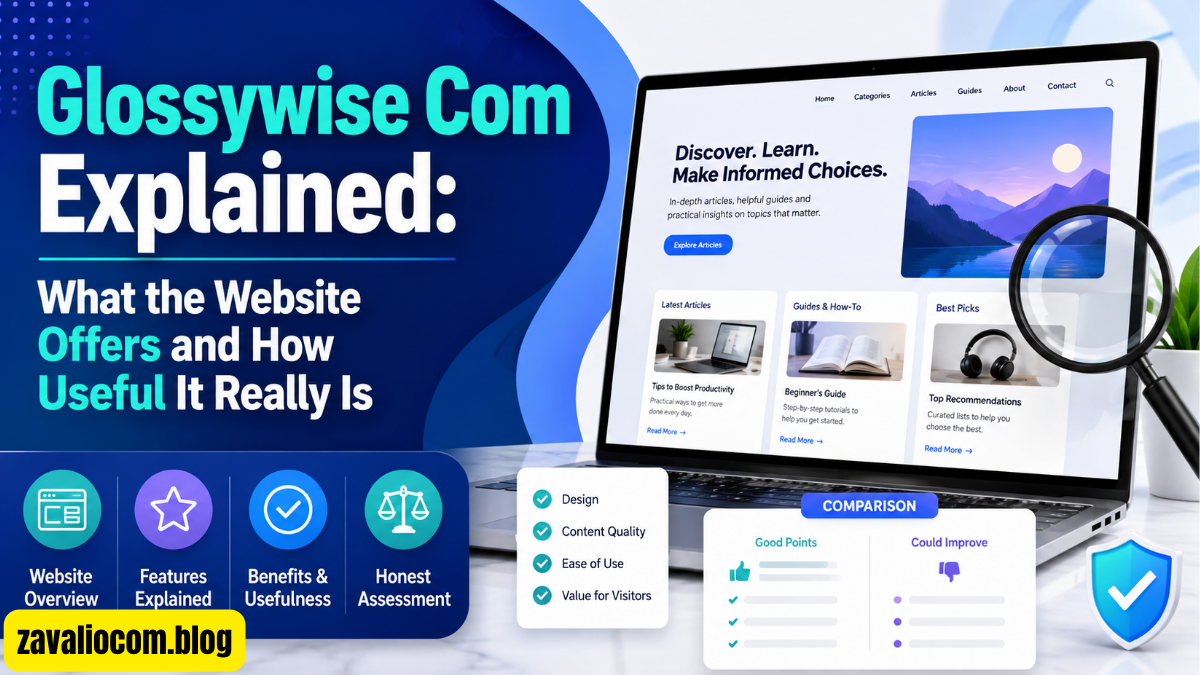
Glossywise Com Explained: What the Website Offers and How Useful It Really Is
Searching for glossywise com can be surprisingly confusing. Depending on which page or search result you land on, the site may sound like a blogging platform for creators, a general digital magazine, or a broad information hub covering everything from business and education to health and travel.
After looking at the current site structure rather than relying only on promotional descriptions, the clearest way to understand it is this: Glossywise.com operates primarily as a multi-topic publishing website. Visitors can browse articles across several categories without paying for access, creating an account, or dealing with a subscription wall.
The site itself describes a broader goal of connecting writers, creators, and readers, but its publicly visible experience feels much more like a traditional content publication than a platform such as Medium or Substack.
That distinction matters, especially if you arrived expecting to create an account, publish your own blog, make money, or use some type of creator dashboard.
What Is Glossywise.com Actually Used For?
At its core, Glossywise.com is designed for reading informational articles.
The main navigation currently highlights six categories: Business, Education, Health, Lifestyle, Technology, and Travel. Its broader archive appears to stretch into subjects such as finance, cryptocurrency, food, shopping, real estate, gaming, pets, home topics, and trading as well.
That makes the site closer to a general-interest online magazine than a specialist publication.
Someone might discover it through an article about artificial intelligence, then notice another post about studying abroad, followed by content about health, marketing, investing, or travel. That broad publishing approach is useful for casual discovery, but it also means readers should not automatically assume the website has specialist expertise in every category it covers.
This is where many online descriptions get the site wrong. A website publishing cryptocurrency articles is not automatically a crypto service. Publishing shopping content does not make it an online store. Writing about blogging does not necessarily mean visitors receive their own hosted blog.
The public-facing product is content.
Why Does the Site Call Itself a Blogging Platform?
This is probably the biggest source of confusion.
The homepage uses language suggesting that writers and creators can share ideas, reach audiences, develop personal brands, and publish content. It even discusses monetization possibilities such as affiliate marketing and advertising.
Yet the visible navigation is centered on article categories rather than obvious community profiles, creator dashboards, membership tools, or publishing controls.
Independent reviews examining the current website have reached a similar conclusion: Glossywise behaves primarily as an editorial blog from the visitor’s perspective, despite broader creator-platform language appearing in its marketing copy.
That doesn’t necessarily mean writers cannot contribute. It means you shouldn’t assume the experience works like WordPress.com, Medium, or Substack simply because the homepage talks about publishing.
If you’re interested in writing for the site, verify the current submission process directly. Check whether contributors receive accounts, whether articles are manually approved, who owns submitted content, whether links are permitted, and whether compensation exists.
Those details matter far more than a general statement about “empowering creators.”
What Kind of Content Will You Find?
The variety is unusually broad.
Business content includes general discussions around companies, workplace issues, marketing, management, payments, and entrepreneurship. Technology articles cover subjects such as AI tools, software, online services, programming-related topics, and digital trends.
Education pages include study advice, teaching topics, classroom management, academic services, and studying abroad. The health section includes wellness alongside more serious subjects such as vitamin deficiencies, Alzheimer’s disease, menopause, mental health, memory, and cardiovascular exercise.
Lifestyle and travel content tends to be easier to evaluate because the consequences of bad advice are generally lower.
That doesn’t make every lifestyle article automatically accurate. It simply means choosing a morning routine based on a general blog carries far less risk than changing medication, investing $10,000, or making a major financial decision based on one article.
I think this is the most sensible way to use broad websites like Glossywise: treat them as discovery tools first and final authorities second.
Is glossywise com Reliable Enough to Trust?
For casual reading, the site has several normal publishing signals.
Articles are organized into categories, and reviews of the site’s archive have identified visible publication dates and recurring author bylines including Devin Haney and Shivi Hyde. Content appears to extend across multiple publishing years rather than consisting of only a handful of recently created pages.
Those are positive signs of an operating publication.
The bigger issue is expertise.
Authors appearing across unrelated subjects may not necessarily have professional qualifications in every field they cover. Publicly visible information reviewed by independent sources does not clearly establish specialist credentials for every health, finance, education, or technology topic.
For a casual article about productivity, that’s not a major concern.
For an article discussing Alzheimer’s disease, investing, legal obligations, supplements, taxes, or another high-impact topic, it becomes much more important.
Here’s the rule I use for general-interest publications: the greater the cost of being wrong, the stronger the source should be.
A $25 skin-care purchase may justify reading several consumer articles and reviews. A medical decision deserves information from a physician, hospital, government health agency, or peer-reviewed research. A $20,000 investment decision deserves substantially stronger evidence than a general finance blog.
The Best Way to Evaluate an Article Before Acting on It
Don’t judge an entire website from its logo or homepage design. Judge the specific page you’re reading.
Start with the publication date. Technology, finance, travel regulations, software instructions, and health recommendations can become outdated quickly.
Then check the author. A name alone is useful, but a detailed biography explaining relevant experience is much stronger.
Next, look for supporting evidence. Specific studies, original statistics, government resources, official documentation, manufacturer instructions, and named expert sources give you something independent to verify.
Pay attention to overly confident claims as well. Statements such as “guaranteed,” “works for everyone,” or “completely risk-free” deserve skepticism, particularly around money and health.
Finally, verify important information somewhere else.
That extra Google search takes perhaps three minutes and can prevent a surprisingly expensive mistake.
Is the Website Free?
Publicly accessible material reviewed in 2026 can be read without a paid subscription or mandatory login. Independent reviewers also report accessing articles without encountering a paywall.
That’s useful for readers who simply want quick information.
There is also no clear indication from the public-facing experience that the website functions as an e-commerce store. Its shopping-related and product-related material appears to be editorial content rather than evidence of a traditional storefront with a cart and checkout system.
Of course, website features can change. If a future page asks for payment or sensitive personal information, evaluate that transaction separately rather than assuming it is trustworthy simply because you previously read a free article on the domain.
What I Like About the Publishing Approach
The strongest part of Glossywise is accessibility.
Broad informational websites work best when they help beginners understand unfamiliar subjects without forcing them through 4,000 words of technical language. The site’s category structure and plain-language approach make it easier to explore a subject before moving to more authoritative or specialized resources.
I also prefer this style over publications that pretend every article needs to sound academic.
If someone wants to understand what an AI tool does, learn basic travel terminology, explore productivity ideas, or get an introduction to a business concept, readability matters.
The weakness is the same thing that creates the advantage: breadth.
A publication covering technology, health, finance, education, travel, lifestyle, crypto, real estate, food, and shopping cannot automatically possess deep institutional authority in every field. Readers need to make that distinction themselves.
What Glossywise.com Is Not
Understanding what the site doesn’t appear to be is almost as helpful as knowing what it publishes.
Based on its current public structure, it should not automatically be treated as:
- a licensed financial advisory service;
- a cryptocurrency exchange or wallet;
- an online medical service;
- a university or educational institution;
- a traditional e-commerce marketplace;
- a replacement for professional legal, medical, or financial advice.
It is primarily an information publisher.
That sounds obvious, but search results frequently blur the line between a website discussing an industry and actually operating within that industry.
Who Will Get the Most Value From It?
The platform makes the most sense for readers in the early stages of researching something.
Imagine you’re trying to understand a technology term you’ve never seen before. A straightforward introductory article can give you the vocabulary needed to research the subject properly.
The same applies to travel planning, general business ideas, lifestyle questions, educational topics, and everyday technology.
Specialists will probably want deeper sources.
A cybersecurity engineer looking for implementation details, for example, is unlikely to rely on a broad consumer technology article. Someone planning retirement shouldn’t build a portfolio around a general finance explainer either.
Use the level of research that matches the decision you’re making.
FAQs
What is Glossywise.com in simple words?
Glossywise.com is a general-interest content website publishing informational articles across multiple topics. Its visible categories include business, education, health, lifestyle, technology, and travel, with additional subjects appearing throughout its wider archives.
Is Glossywise.com legit or a scam?
It appears to be an active content publication rather than an obvious scam operation, but that doesn’t make every article automatically authoritative. Evaluate individual pages, authors, evidence, and any requests for personal or payment information separately.
Do I have to pay to read Glossywise articles?
Public articles reviewed in 2026 are available without a subscription or reading fee. There is also no mandatory account requirement for accessing the normal editorial content examined by reviewers.
Can I publish articles on Glossywise.com?
The site’s homepage talks extensively about writers and content publishing, but the public visitor experience does not clearly show the kind of self-service publishing dashboard found on established creator platforms. Anyone wanting to contribute should verify the current submission process and content terms directly before sending an article.
Should I trust its health and finance articles?
Use them for introductory research, not as your only source for important decisions. Medical questions should be checked against qualified healthcare sources, while major financial decisions should be verified through appropriate professional, regulatory, or primary sources.
The simplest way to approach Glossywise.com is to appreciate it for what it currently does well: providing broad, accessible information across a large range of subjects. Its variety makes it useful for discovering topics and getting quick introductions, but readers should resist confusing breadth with specialist authority. Read freely, follow interesting ideas, and verify anything that could seriously affect your health, finances, education, or legal position.