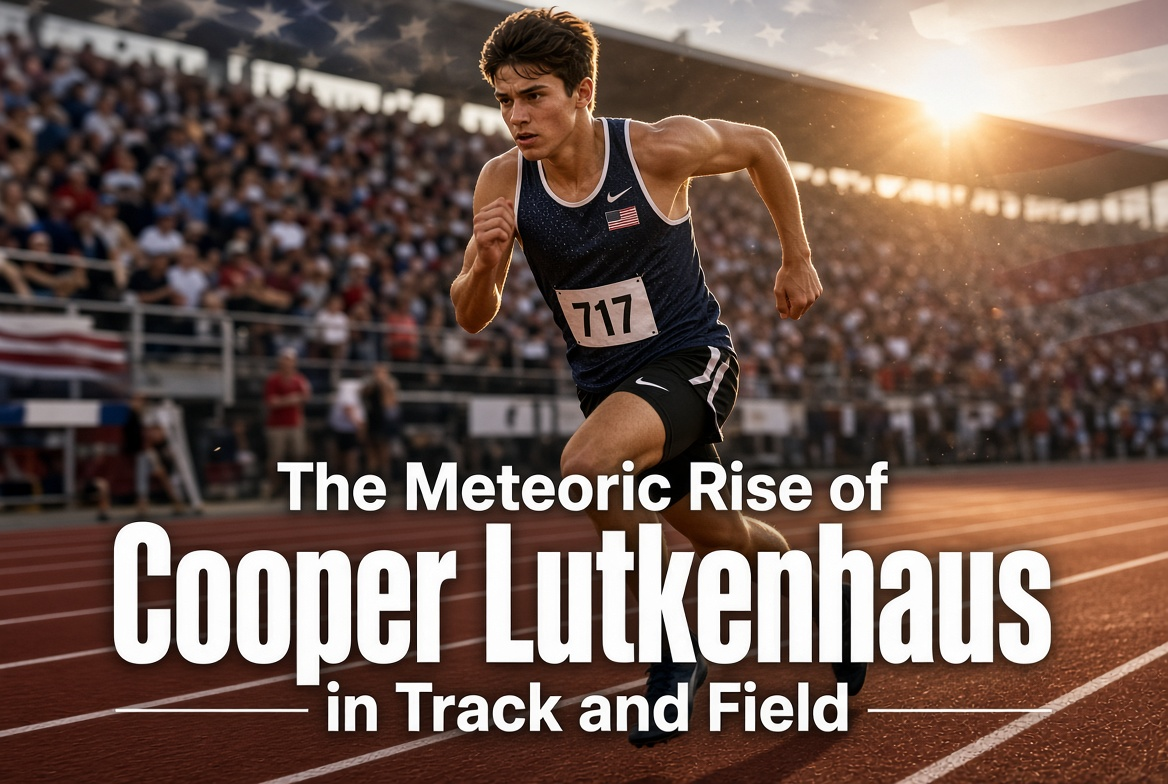
The Meteoric Rise of Cooper Lutkenhaus in Track and Field
In the fast-paced world of middle-distance running, few stories capture the imagination quite like that of a high school student from a small Texas town who suddenly finds himself standing on the podium at a world championship. Cooper Lutkenhaus has done exactly that, turning heads across the globe with performances that seem almost unreal for someone still navigating the halls of Northwest High School. Born on December 19, 2008, this quiet powerhouse from Justin, Texas, has rewritten the script for what a teenage athlete can achieve. From backyard races with his brothers to signing a professional deal with Nike while still in high school, his journey blends raw talent, family support, and a racing intelligence that coaches and competitors alike cannot stop talking about. What makes it even more compelling is how grounded he remains, still treating track as something he loves rather than a pressure-filled career. Readers looking for inspiration in sports will find plenty here, as his story shows that big leaps can happen when preparation meets opportunity at the perfect moment.
The 800 meters demands a rare mix of speed endurance and tactical smarts, and this young American has shown both in abundance. Early on, he was just another kid testing himself after school, yet those simple efforts laid the foundation for records that once seemed out of reach for high schoolers. Now competing against Olympic medalists and seasoned professionals, he continues to improve while balancing the everyday realities of teenage life. His path offers a fresh look at how modern track and field is evolving, with athletes turning pro earlier than ever and still managing schoolwork and friendships. As we explore the details of his background, breakthroughs, training, and future, one thing becomes clear: this is a talent built for the long haul, and the best chapters may still be ahead.
Early Life and Family Roots in Justin, Texas
Growing up in Justin, a quiet community north of Fort Worth, shaped the athlete we see today in ways both subtle and profound. The Lutkenhaus household was already steeped in sports long before the youngest son laced up spikes for serious competition. His parents, George and Tricia, brought their own athletic backgrounds into the family dynamic. George had competed in cycling and ran the 800 meters at the University of North Texas, while Tricia earned multiple Texas state qualifications in the 4×400-meter relay. Those experiences created an environment where movement and competition felt natural rather than forced. The three brothers, with Cooper as the youngest, often found themselves testing limits together, whether in informal races or simply through shared energy after school.
That early exposure mattered. What began as elementary school assignments involving timed 800-meter efforts after class gradually grew into something more intentional. By the time he reached middle school, the pieces were coming together. He was not initially obsessed with the track; football, specifically playing quarterback, held his attention for a while. Yet the pure joy of running, combined with the quiet encouragement from his family, kept pulling him back. Living in a place that values hard work over flashy headlines helped keep everything in perspective. Neighbors and classmates knew him as a regular kid who mowed lawns, danced when the mood struck, and played video games like anyone else his age. That normalcy has stayed with him even as the spotlight has grown brighter, giving him a foundation that many prodigies lack. The Texas high school scene, known for its fierce competition, provided the perfect proving ground without overwhelming him too soon.
Family remains central. Older brothers Andrew and George Jr. pursued their own athletic paths, with Andrew later earning a track scholarship. Shared training sessions and mutual support created a built-in support system that continues today. When the big moments arrived, parents and siblings positioned themselves around the track, filming, cheering, and offering calm presence. That kind of steady backing allowed the young runner to focus on the process rather than the outcome, a mindset that has served him well under increasing pressure. The small-town setting also meant that early successes felt community-sized rather than world-sized, giving him room to grow without immediate national scrutiny. All of these elements combined to produce an athlete who approaches elite competition with surprising ease and humility.
Discovering the 800 Meters and Early Breakthroughs
The shift toward specializing in the 800 meters happened gradually and almost organically. Early races in the 400 meters showed speed, but the two-lap event unlocked something deeper. By the summer between eighth and ninth grade, he was already winning major national high school meets, taking both the 400 and 800 titles at Nike Outdoor Nationals with times that turned heads. Those victories felt almost ordinary to him at the time, a telling sign of how high his internal standards already sat. The following seasons brought state titles in Texas, first in the 5A classification as a freshman and then the 6A crown as a sophomore, along with a state record that stood out even in one of the deepest high school scenes in the country.
Progress came in measurable steps. Indoor and outdoor high school records fell one after another. A 1:46.86 at the Millrose Games in the professional section broke the indoor national high school mark. Later, a wire-to-wire 1:46.26 at the Brooks PR Invitational erased a 29-year-old outdoor high school record. Each performance built confidence without creating complacency. Coaches noticed the combination of natural speed and an ability to close races with real power. Training remained rooted at the high school level under supportive guidance, first with one coach and later with Chris Capeau at Northwest High School. The environment allowed experimentation and steady volume while protecting the body of a still-growing teenager. Rather than chasing every available race, the focus stayed on quality sessions and recovery, a mature approach that prevented burnout.
What set these early years apart was the willingness to race up in competition. Entering professional fields while still a high school sophomore tested both fitness and nerve. Finishing near the front in those settings provided feedback that high school-only meets could not. The experience also revealed a racing brain that processed positions and tactics quickly. Instead of panicking when boxed in or falling behind early, he learned to wait for the right moment to strike. That patience would become a signature trait later. By the time the 2025 outdoor season arrived, the foundation was solid enough to support a leap that few expected, even among those closest to him. The progression from local talent to national high school standout happened in clear stages, each one preparing him for the next level without skipping essential development.
The Breakthrough Season That Changed Everything
The summer of 2025 marked the moment the track world fully woke up to this Texas teenager. At the USATF Outdoor Championships in Eugene, Oregon, he navigated the rounds with composure, surviving a near fall in the semifinals before delivering a final that still draws gasps when replayed. Sitting well back with 200 meters remaining, he produced a ferocious kick that carried him past several established professionals and into second place behind Donavan Brazier. The clock stopped at 1:42.27, a time that obliterated the previous under-18 world best and ranked among the fastest ever run by an American of any age. Suddenly, the youngest man to qualify for a World Championships final at the national level had earned a ticket to Tokyo and rewritten age-group history in the process.
That single race accelerated everything. Conversations about the future intensified. Turning professional while still having high school eligibility remaining was not the original plan. College had always looked attractive, both for competition and education. Yet the performance created an opportunity that was hard to ignore. After thoughtful family discussions, the decision came: sign with Nike. At 16 years and roughly eight months, he became one of the youngest American track athletes to turn pro and the youngest ever for the brand in the sport. The contract allowed him to continue training under his high school coach while accessing resources that supported recovery, travel, and professional-level preparation. Little changed day to day at first. He still attended classes when possible, trained with familiar teammates, and kept the same grounded routine that had gotten him this far.
The Tokyo World Championships provided the first real taste of global senior competition. An early exit in the opening round was disappointing but instructive. Competing against the deepest field of his life taught lessons about pacing, positioning, and the physical demands of championship racing that no domestic meet could match. Rather than treating the result as a setback, he absorbed the experience and used it as fuel. By the end of that year, the trajectory was clear. A high school junior had become a professional athlete with a world-class personal best, a major sponsorship, and a growing reputation for closing speed that few could match. The season proved that talent combined with the right support system can compress years of development into a handful of months.
Training Approach and the Work Behind the Times
Behind every record and podium appearance sits a consistent training philosophy that prioritizes quality over quantity. Sessions often begin before school, taking advantage of cooler morning temperatures and quieter facilities. One signature workout involves three 300-meter repeats followed by four 150-meter efforts, designed to mimic the demands of racing an 800: sustained speed early, then an even faster finish while maintaining form. Targets around 39 seconds for the 300s translate roughly to race-pace effort, giving the body specific practice for the physiological stress of the event. These sessions are demanding yet carefully managed to allow recovery before the next hard day.
The overall plan blends speed development with aerobic strength and technical refinement. Strength work supports the powerful finishing kick that has become a trademark. Recovery receives equal attention, with attention to sleep, nutrition, and listening to the body when minor niggles appear. An IT-band issue once threatened a key championship, yet careful management allowed a full return and a career-best performance shortly afterward. That ability to stay healthy while increasing training load separates lasting talents from short-term flashes. Coaching remains collaborative. Chris Capeau continues to oversee the day-to-day work at the high school level, providing continuity and a familiar environment even after the professional move. Outside input comes when needed, but the core group stays small and trusted.
Mental preparation receives quiet but consistent focus. Visualization of race scenarios, controlled breathing under fatigue, and a simple process-oriented mindset help keep external noise at bay. He has spoken about dreaming of speed workouts, a sign that the work itself has become intrinsically motivating rather than a chore. Racing strategy has matured alongside the physical tools. Early positioning, patience through the first lap, and an explosive second-lap surge appear again and again in successful performances. That combination of physical gifts and tactical awareness is rare at any age and especially unusual in a teenager. The result is an athlete who can win from the front or come from behind, adapting to the flow of each race rather than forcing a single style.
Historic World Indoor Title and Diamond League Success
The indoor season of 2026 delivered the crowning early achievement. At the World Athletics Indoor Championships in Toruń, Poland, the then-17-year-old produced a composed and decisive performance to claim gold in the 800 meters. The winning time of 1:44.24 not only secured the title but also established him as the youngest male individual world champion in the history of the championships, indoors or outdoors. Spring break for most high school juniors involves rest and recreation; for this one it involved standing on the top step of a world podium while representing the United States. The victory capped a strong indoor campaign that also included a national title and a short-track under-20 world record of 1:44.03.
Outdoor racing that year continued the momentum. Diamond League appearances brought victories over Olympic champions and established stars. Beating Emmanuel Wanyonyi, the Olympic gold medalist, and Marco Arop, a world champion and North American record holder, in successive high-level races announced that the teenager belonged at the absolute top of the event. The racing style remained consistent: smart positioning, controlled aggression, and a finishing gear that left rivals reaching. National titles indoors and outdoors completed a sweep that few athletes of any age achieve in a single year. By mid-season the win-loss record in finals stood at a remarkable level, with only rare setbacks interrupting an otherwise dominant stretch.
These results carried extra weight because of the athlete’s age and the context of still attending high school. Missing classes for international travel and championships required careful coordination with school staff and family. Yet the support system held, allowing him to remain connected to teammates and the everyday rhythm of student life. The combination of elite results and normal teenage experiences has become part of the public narrative, humanizing a career that could otherwise feel distant. Fans and fellow athletes respond to that authenticity. Quotes from competitors after races often highlight not only the speed but the maturity and respect shown on and off the track. That dual reputation strengthens the foundation for whatever comes next.
Personal Bests, Records, and Career Snapshot
A clear picture of progress emerges when looking at the progression of times and major results. The following table summarizes key personal bests and milestone achievements as of the most recent competitive season.
| Event | Time | Context | Year |
|---|---|---|---|
| 800m Outdoor | 1:42.08 | World under-18 / under-20 record territory | 2026 |
| 800m Indoor (short track) | 1:44.03 | World under-20 record | 2026 |
| 600m | 1:14.15 | World under-20 best | 2026 |
| 400m | 46.30 | Strong supporting speed | 2025 |
| World Indoor Championships | Gold | Youngest male individual champion | 2026 |
| US Outdoor Championships | Silver (2025), Gold (2026) | Breakthrough and title sweep | 2025-2026 |
| Diamond League | Multiple wins | Victories over Olympic and world medalists | 2026 |
These numbers tell only part of the story. The qualitative leap from high school national records in the mid-1:46 range to sub-1:43 performances against professionals represents an extraordinary rate of improvement. Supporting events such as the 400 and 600 meters provide the speed base that makes the 800 so dangerous. Records continue to fall or approach all-time lists, placing a still-developing athlete among historical names. The table also underscores consistency across indoor and outdoor surfaces, a sign of well-rounded preparation.
Quotes from those around him reinforce the numbers. One rival after a Diamond League race noted the special talent and the likelihood of continued improvement. Another observed the rare combination of physical tools and racing intelligence at such a young age. From the athlete himself comes a simple reflection after beating top international competition: the desire to prove belonging in those races, more to himself than to anyone else. Such statements reveal a competitor driven by internal standards rather than external validation. That internal compass has guided decisions from the professional contract to race selection and daily training choices. Looking at the full snapshot, the career already contains more history-making moments than many athletes accumulate in a decade, yet the chronological age suggests the peak years remain ahead.
Balancing High School Life with Professional Demands
One of the most striking aspects of the story is the continued presence in a high school environment. Classes, friends, and the familiar routine of Northwest High School remain part of the weekly rhythm whenever travel allows. Teammates treat him largely the same, offering a dose of normalcy that elite sport often strips away. Morning workouts finish in time for school, and afternoon sessions fit around academic responsibilities. When major championships require absences, school staff and family coordinate make-up work so progress toward graduation stays on track. That dual existence is rare and requires unusual discipline from the athlete and flexibility from the supporting adults.
Social life has not disappeared. Country music, dancing, video games, and simple downtime still occupy free hours. The ability to switch off from training and competition protects long-term motivation. Friends from the high school team provide a peer group that understands the demands without treating every conversation as a performance review. This balance helps explain the sustained improvement. Many young talents struggle when the only identity becomes “athlete.” Here the identity remains broader: student, brother, friend, and runner. The professional resources from Nike enhance recovery and travel logistics without removing the grounded daily structure that developed the talent in the first place. Maintaining that structure while competing at the highest level is itself an achievement worth noting.
Challenges exist, of course. Jet lag, missed social events, and the mental load of representing a country at a young age require management. Yet the support network of family, coaches, and school has proven effective so far. The result is an athlete who can step into a world final and then return to classroom discussions without losing either focus or sense of self. That continuity may prove one of the smartest long-term decisions in a career already full of bold moves. Observers watching the next few seasons will likely note not only the times but the sustained health and enthusiasm that come from a life still rooted in familiar places and people.
Looking Ahead to Future Goals and Olympic Aspirations
The trajectory points toward continued improvement and major outdoor championships. With an already impressive résumé that includes a world indoor title, national sweeps, and Diamond League victories, the logical next targets involve outdoor global medals and, eventually, the Olympic Games. American middle-distance history has long waited for a sustained presence at the very top of the 800 meters; the current generation of talent, led by this teenager, offers real hope. Physical development still has room to continue, as does the refinement of racing tactics against the deepest fields. Careful management of volume and intensity will remain essential to avoid the injury risks that can derail young careers.
Sponsorship and professional support provide the platform for optimal preparation. Access to better recovery tools, travel assistance, and competition opportunities removes many of the barriers that once limited high school athletes. At the same time, the decision to stay connected to the high school coaching environment preserves the training relationship that produced the initial breakthrough. That hybrid model may become more common as other talents consider early professional paths. Beyond individual results, the broader impact includes inspiration for the next wave of American middle-distance runners. Seeing a peer succeed at the highest level while still in school can shift what young athletes believe is possible.
Ambition remains measured. Public comments focus on process, belonging, and continued learning rather than specific medal counts or record targets. That approach has served well so far and is likely to continue. As the body matures and experience accumulates, the already formidable closing speed and tactical awareness should only grow more dangerous. Fans of the sport have every reason to follow the coming seasons closely. The combination of youth, proven results, and a stable support system creates one of the most compelling stories in current track and field. Whatever the exact timeline of future milestones, the foundation is already remarkably solid.
Conclusion
The story Cooper Lutkenhaus of this Texas teenager stands as a reminder that extraordinary talent can emerge from ordinary beginnings when curiosity, family support, and consistent work align. From informal after-school efforts to a world championship gold medal and professional success while still in high school, the arc has been steep yet carefully managed. Records have fallen, Olympic medalists have been beaten, and a new standard for what a young American middle-distance runner can achieve has been set. Through it all, the athlete has remained recognizably himself: competitive on the track, grounded off it, and focused on the daily process more than the headlines.
What comes next will depend on continued health, smart training, and the natural progression of a still-developing body and mind. The sport will benefit from watching the evolution. Younger runners will find a blueprint that includes both elite performance and a balanced life. Fans will enjoy the races, the kicks, and the quiet confidence that has already produced so many memorable moments. In a discipline that rewards patience as much as power, this career has already demonstrated both in abundance. The chapters written so far are impressive; the ones still unwritten hold even greater promise.
Who is Cooper Lutkenhaus and why has he become so well known?
Cooper Lutkenhaus is an American middle-distance runner from Justin, Texas, specializing in the 800 meters. He gained widespread attention after a stunning second-place finish at the 2025 US Outdoor Championships with a world under-18 record time, followed by turning professional with Nike while still in high school and later winning the 2026 World Indoor Championships gold medal as the youngest male individual champion in the event’s history. His combination of record-breaking speed, tactical maturity, and continued high school life has made him one of the most talked-about young talents in track and field.
What are the major records and titles held by Cooper Lutkenhaus?
Key achievements include the world under-18 outdoor 800-meter record, the world under-20 short-track 800-meter record, a world indoor championship gold medal in 2026, US indoor and outdoor national titles, and multiple Diamond League victories over Olympic and world medalists. Supporting personal bests in the 400 and 600 meters further highlight the speed base that powers his two-lap racing. These results place him among the fastest Americans all-time despite his young age.
How did Cooper Lutkenhaus decide to turn professional so early?
After the breakthrough 1:42.27 performance at the 2025 US Championships, conversations with family and advisors led to the decision to sign with Nike. The move provided professional resources while allowing continued training under his high school coach and maintenance of academic progress. It was not taken lightly, as college competition had been part of the original plan, yet the opportunity to compete at the highest level immediately proved compelling.
What does a typical training week look like for Cooper Lutkenhaus?
Training often starts early in the morning before school and includes specific speed sessions such as 300-meter and 150-meter repeats designed to build race-specific endurance and finishing power. Strength work, recovery practices, and careful monitoring of volume help sustain progress without injury. The overall approach balances high-intensity efforts with adequate rest, all while fitting around school and travel demands.
What are the future goals for Cooper Lutkenhaus in track and field?
While specific medal targets are kept private, the natural progression points toward outdoor world championship medals and Olympic competition. Continued physical development, tactical refinement, and health management form the foundation for those ambitions. The existing support system of family, coaches, and professional partners positions him well to pursue those goals over the coming years while remaining grounded in the process that has already produced historic results.