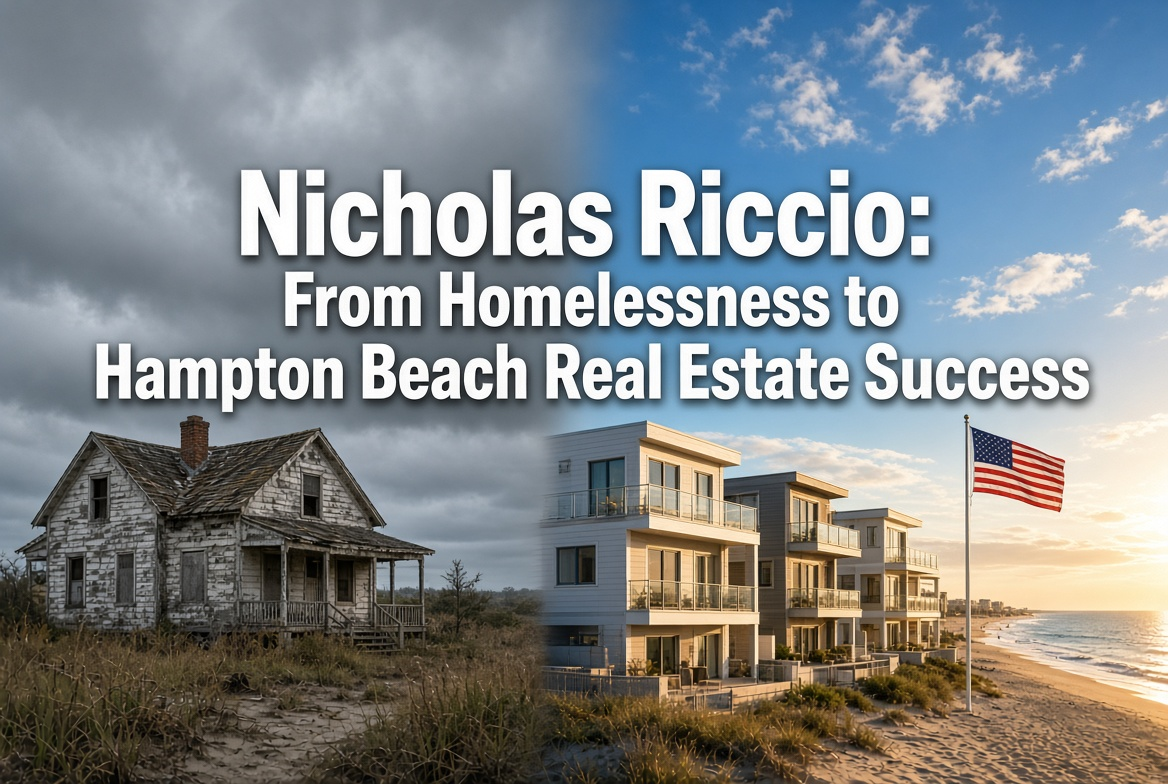
Nicholas Riccio: From Homelessness to Hampton Beach Real Estate Success
Nicholas Riccio stands as a striking example of American entrepreneurial grit in the world of real estate. Born into modest circumstances in New Hampshire, he transformed personal hardship into a thriving property portfolio centered on Hampton Beach. His story captures attention not only for the financial success but for the sheer determination that carried him through years of instability. Readers drawn to tales of self-made success find in him a figure who rebuilt neighborhoods one building at a time while maintaining a relatively private life even as public interest grew around his family.
The path he followed involved calculated risks, high-interest loans in the early days, and a sharp eye for undervalued properties in a seasonal tourist town. What began as a single purchase on a neglected street evolved into ownership of multiple buildings and dozens of rental units. Today his companies manage vacation rentals, beach houses, apartments, and a motel that serve both long-term tenants and summer visitors. This foundation of steady rental income and property appreciation forms the core of his financial standing, estimated by various reports in the multimillion-dollar range. Understanding his background helps explain how a young man who once slept in his car could later support a high-profile political spouse and young family without relying on celebrity or inherited wealth.
Early Life and the Challenges That Shaped Him
Growing up in Hudson, New Hampshire, Nicholas Riccio experienced the kind of family upheaval that forces early independence. His parents, Anthony and Marilyn, divorced when he was young, leaving a household of four children navigating frequent moves and financial strain. School changes became routine, and the instability left lasting marks. By his late teens the difficulties intensified to the point of homelessness. He has spoken of periods spent sleeping in his car and relying on friends for basic needs such as showers, sometimes using sports-watching visits as a practical excuse to clean up.
Those years built a practical resilience that later served him well in business. Working at a grocery store while attending college required discipline and the ability to stretch limited resources. The experience of scarcity taught him to recognize value where others saw only decline. Rather than remaining stuck in survival mode, he began looking for ways to create stability through ownership. This mindset of turning overlooked opportunities into assets became the through-line of his adult career. Friends and local acquaintances from that era later noted how the same determination that kept him going during hard times showed up in the methodical way he renovated properties.
The contrast between those early struggles and later achievements makes the narrative compelling for anyone interested in personal turnaround stories. It also provides context for why he focused so intently on improving physical spaces. Renovating run-down buildings mirrored, in a tangible way, the process of rebuilding his own circumstances. That parallel is not lost on observers who see his portfolio as more than an investment vehicle; it represents years of persistent effort applied to both personal and community improvement.
Education and the Decision That Changed Everything
After graduating from Alvirne High School in Hudson in 1983, Nicholas Riccio pursued studies at Plymouth State University. Supporting himself through school meant balancing coursework with jobs and careful budgeting. The academic environment gave him structure, yet the real pivot came outside the classroom. In 1990 he enrolled in a real estate course that introduced the fundamentals of property acquisition, financing, and renovation. That single class opened a practical path that aligned with his growing interest in turning neglected assets into productive ones.
The timing mattered. The early 1990s offered pockets of distressed real estate in New Hampshire beach towns where tourist demand still existed but physical conditions had deteriorated. Armed with new knowledge and a willingness to take on debt at high interest rates, he began evaluating opportunities. The education was not theoretical for long. It translated quickly into action when he identified a stretch of properties that others had largely abandoned. Formal learning combined with street-level observation created a hybrid skill set that proved more valuable than any single degree.
Many people take similar courses without acting on them. What distinguished his approach was the immediate application under financial pressure. Borrowing money when cash was scarce required confidence in the eventual upside of renovations and rentals. That willingness to move from classroom concepts to real transactions marked the beginning of a multi-decade career. Looking back, the real estate course stands as the clear inflection point between survival and intentional wealth building.
Discovering Opportunity on M Street in Hampton Beach
A drive through Hampton Beach with his mother in the early 1990s revealed a street lined with buildings in various states of disrepair. M Street had acquired a reputation for problem properties, some even condemned. Seasonal rentals had left the area looking tired, and serious investors had largely moved on. Where others saw liability, Nicholas Riccio saw potential. The location near the beach meant tourist traffic remained strong, yet the physical condition of the structures kept values depressed. That combination of location strength and asset weakness presented a classic value-add opportunity.
He started with one building, stretching his limited resources and accepting high-interest financing. The first renovation set a pattern: clean up the exterior, improve interiors, and position the units for more reliable tenants or vacation guests. Each successful project generated cash flow and equity that supported the next purchase. Over the following years the strategy compounded. By the mid-2000s he controlled a significant portion of the street, with reports of fifteen buildings and roughly seventy living units under his management. Local observers credited the cumulative effect of these renovations with improving the overall appearance and rental quality of that section of Hampton Beach.
The concentration of ownership on a single street created operational efficiencies. Maintenance, marketing, and tenant management could be handled more effectively when properties sat close together. It also allowed him to influence the character of the neighborhood rather than simply owning isolated assets. That hands-on, place-based approach remains a hallmark of his business philosophy. Instead of chasing distant markets or speculative development, he doubled down on a location he understood intimately and improved it incrementally over decades.
Building Riccio Enterprises LLC and Expanding the Portfolio
Formalizing the operation, Nicholas Riccio established Riccio Enterprises LLC as the primary holding company. The entity provided structure for acquisitions, renovations, and ongoing management. A related brand, Nautical Beach Properties, handled the consumer-facing side of vacation rentals, beach houses, apartments, and motel rooms. The dual structure allowed clear separation between ownership and daily guest operations while presenting a cohesive brand to visitors seeking ocean-side lodging.
Expansion beyond the original M Street cluster eventually included properties stretching toward Boston and into the White Mountains, plus at least one holding in West Virginia. The core remained Hampton Beach, where seasonal demand for short-term rentals complemented steadier long-term leases. Rates for rooms and houses varied with the season, providing higher returns during peak summer months and more predictable income in the off-season. The Nautical Motel added a commercial lodging component that further diversified revenue streams.
Public records in later years showed multiple related limited liability companies tied to specific addresses, reflecting careful entity structuring common among experienced real estate operators. Mortgage activity indicated ongoing leverage used to support additional purchases or improvements. The overall picture is one of disciplined growth rather than rapid speculation. Properties acquired years earlier for modest sums appreciated substantially as the Hampton Beach market strengthened, illustrating the power of patient ownership in a desirable location.
Net Worth Estimates and the Reality of Real Estate Wealth
Public estimates of Nicholas Riccio’s net worth typically fall in the six-to-ten-million-dollar range, with some higher figures appearing in less rigorous reporting. The more conservative and commonly cited numbers around six million dollars appear grounded in visible property assessments and operating businesses. Higher estimates closer to ten million dollars account for decades of appreciation on assets purchased when prices were far lower. Gross values of the known Hampton Beach portfolio have been placed in the nine-to-twelve-million-dollar range before subtracting any remaining debt.
Real estate net worth differs from liquid wealth. Equity builds slowly through principal pay-down, market appreciation, and successful renovations. Income arrives primarily through rents rather than salary or stock options. This structure provides relative stability but also requires ongoing attention to maintenance, occupancy, and local market conditions. Seasonal tourism in Hampton Beach introduces variability that longer-term residential leases help smooth. The absence of flashy public stock holdings or celebrity endorsements means the fortune rests almost entirely on tangible property performance.
Financial disclosures connected to his wife’s public role have confirmed the existence of real estate and business interests without revealing precise equity figures. That opacity is typical for private operators. What remains clear is that the wealth predates any political association and stems from the long process of buying, improving, and holding income-producing assets. For readers evaluating similar paths, the lesson centers on the compounding effect of consistent local investment rather than sudden windfalls.
Meeting Karoline Leavitt and Building a Shared Life
Nicholas Riccio crossed paths with Karoline Leavitt in 2022 during her congressional campaign in New Hampshire’s First District. A mutual friend hosted an event at a restaurant, and the two became acquainted through that political and social circle. What began as professional and social contact developed into a personal relationship. Engagement followed in December 2023, announced publicly with warm personal statements. The couple married in January 2025 at Wentworth By the Sea Country Club in Rye, New Hampshire, shortly before a presidential inauguration that brought additional public attention.
The thirty-two-year age difference drew commentary, yet those close to the pair have described a supportive partnership. Leavitt has spoken of his steady presence and the flexibility his established business provided as her career demands intensified. For his part, the relationship introduced a new chapter of family life after years focused primarily on business. The public nature of her subsequent White House role inevitably increased visibility around both of them, yet he has largely remained behind the scenes, consistent with earlier preferences for privacy.
Their story illustrates how personal connections formed in local political and business networks can lead to unexpected life changes. Campaign work, mutual acquaintances, and shared New Hampshire roots created the initial overlap. From there the relationship progressed on its own timeline, resulting in marriage and children. Observers note that the pairing combines a high-visibility public role with a more private entrepreneurial background, creating a complementary dynamic.
Family Life and the Arrival of Children
The couple welcomed their first child, a son named Nicholas Robert and nicknamed Niko, in July 2024. A daughter, Viviana, often called Vivi, arrived in May 2026. These milestones shifted priorities toward hands-on parenting alongside ongoing business responsibilities. Descriptions of family life emphasize ordinary moments shared amid the demands of public service and property management. Social media glimpses occasionally offered by Leavitt show affectionate family scenes without extensive detail, reflecting a desire to protect the children’s privacy.
Raising young children while one parent holds a demanding national role requires coordination and reliable support systems. The flexibility inherent in owning and managing real estate appears to have allowed greater availability for family responsibilities. This balance between professional commitments and home life forms an important part of the current chapter. Friends and observers have remarked on the genuine warmth present in the household, suggesting that the relationship provides mutual grounding amid external pressures.
Parenthood also adds a longer-term dimension to the real estate holdings. Properties that generate income today may one day form part of a family legacy or educational resource. That intergenerational perspective is common among long-term property owners and adds meaning beyond pure financial return. For now the focus remains on the present, navigating early childhood while maintaining the businesses that support the household.
Personal Style, Interests, and Approach to Privacy
Those who know Nicholas Riccio describe an introverted personality more comfortable with practical work than public attention. Sports fandom appears as a consistent interest, with collections of memorabilia reflecting long-standing enthusiasm. The upstairs of one of his homes has been characterized as a virtual museum of signed items and photographs spanning boxing, basketball, and other sports. This personal passion offers a counterpoint to the day-to-day demands of property management.
Privacy has remained a priority even as external interest increased. He rarely seeks media attention and allows the properties and business results to speak for themselves. That low-profile approach aligns with many successful real estate operators who prefer steady operations over publicity. When public comments do surface, they tend to emphasize hard work, the value of renovation, and the satisfaction of improving physical spaces. The consistent theme is practical achievement rather than self-promotion.
Maintaining privacy while married to a highly visible official requires deliberate boundaries. The couple appears to manage those boundaries by limiting detailed personal disclosures and focusing public conversation on professional matters when necessary. This measured approach helps preserve space for ordinary family life amid broader scrutiny.
The Broader Impact on Hampton Beach and Local Real Estate
Concentrated ownership and systematic renovation on M Street produced visible changes in the local landscape. Buildings that once contributed to a sense of decline now form part of a cleaner, more marketable rental inventory. Local officials in earlier years noted the positive effect on neighborhood appearance and the quality of available housing. Seasonal visitors benefit from updated options ranging from motel rooms to full beach houses, while longer-term tenants gain improved living conditions.
The strategy of focusing on one street and gradually expanding influence demonstrates how individual operators can shape micro-markets. Rather than dispersing capital across distant cities, the concentrated approach created operational advantages and neighborhood-level impact. Other investors watching the results may draw lessons about the power of patient, place-based improvement. Hampton Beach itself continues to attract tourists drawn to the coastline, and well-maintained lodging supports that economy.
Beyond the immediate street, the presence of reliable rental inventory contributes to the overall health of the local hospitality sector. Guests seeking ocean access, nearby entertainment, and convenient lodging find options that meet varying budgets. This supply of quality rentals strengthens the destination’s appeal and supports related businesses such as restaurants and retail. In that sense the private investment produces public spillover benefits that extend beyond the balance sheet of any single owner.
Lessons Drawn from a Long Real Estate Career
Several practical principles emerge from the trajectory. First, the ability to recognize value in distressed assets requires both market knowledge and the courage to act when capital is limited. Second, consistent improvement over years compounds more reliably than attempts at rapid flipping in most markets. Third, concentrating effort in a familiar location can yield efficiencies and influence that scattered investments rarely match. Fourth, formalizing operations through proper entities and brands supports sustainable growth and clearer management.
Patience stands out as a recurring theme. Properties purchased in the 1990s for relatively modest sums later supported substantially higher valuations and rental rates. Holding through market cycles, continuing renovations, and maintaining occupancy produced the equity that forms the bulk of reported net worth. High-interest early financing was a necessary bridge rather than a permanent structure. As cash flow improved, the overall leverage position could stabilize.
For aspiring investors the story offers encouragement tempered by realism. Success required decades of effort, acceptance of early financial pressure, and continuous attention to physical assets. It did not arrive through a single dramatic deal or external windfall. The combination of personal resilience forged in difficult years and practical skills acquired through education and experience created the conditions for long-term results.
Related Themes in Contemporary Real Estate and Personal Finance
Stories like this one resonate because they touch broader conversations about mobility, housing, and the role of small-scale operators in local economies. Many coastal and tourist towns contain pockets of older housing stock that can either decline further or be renewed through private investment. Operators willing to perform the unglamorous work of renovation often capture both financial returns and community improvement. The seasonal nature of places such as Hampton Beach adds complexity, requiring careful management of cash flow across peak and off-peak periods.
At the personal level the narrative intersects with discussions of age-gap relationships, public versus private careers, and the intersection of business success with political visibility. These elements attract media interest, yet the underlying economic story remains independent of them. The properties and the companies that manage them existed and generated returns long before any national spotlight appeared. Separating the business foundation from later personal developments helps keep the analysis grounded.
Readers interested in similar paths often examine questions of financing, local market research, and the daily realities of property management. While individual circumstances differ, the core sequence of education, identification of undervalued assets, disciplined renovation, and patient holding appears repeatedly among successful small-scale real estate entrepreneurs. The particular details of one New Hampshire operator simply illustrate those principles in concrete form.
Here is a quick-reference profile summary:
| Category | Details |
|---|---|
| Full Name | Nicholas Riccio |
| Nickname | Nick |
| Approximate Birth Year | 1965 |
| Hometown | Hudson, New Hampshire |
| Education | Alvirne High School; Plymouth State University; real estate course 1990 |
| Primary Business | Riccio Enterprises LLC; Nautical Beach Properties |
| Focus Area | Hampton Beach rentals, renovations, motel operations |
| Estimated Net Worth Range | $6 million to $10 million |
| Spouse | Karoline Leavitt |
| Children | Son Niko (2024); daughter Vivi (2026) |
“Success in real estate often comes down to seeing what others overlook and then doing the hard work of improvement day after day,” one longtime observer of local property markets has noted in describing similar turnaround stories. Another common reflection among operators is that “the best deals are the ones you hold long enough for the location and the renovations to do their work.”
Conclusion
The journey of Nicholas Riccio offers a detailed case study in persistence applied to real estate. From periods of genuine hardship to ownership of a meaningful portfolio of income-producing properties, the path demonstrates how focused effort in a known market can produce lasting results. The businesses he built continue to serve both local housing needs and the tourist economy of Hampton Beach. Family life has added new dimensions of meaning and responsibility in recent years. Taken together, the professional achievements and personal chapters form a coherent narrative of steady progress rather than sudden transformation. For those following similar ambitions or simply curious about the human stories behind local property markets, the example provides both practical insight and genuine inspiration.
FAQ
What is known about the early struggles of Nicholas Riccio?
He experienced significant financial instability after his parents’ divorce and faced periods of homelessness in his late teens and early twenties. Sleeping in a car and relying on friends for basic needs became part of that chapter. Those experiences appear to have strengthened the determination that later fueled his business efforts. The contrast between those years and subsequent property ownership forms a central part of the public narrative around his life.
How did Nicholas Riccio get started in real estate?
After attending Plymouth State University and working to support himself, he took a real estate course in 1990. That education led him to identify distressed buildings on M Street in Hampton Beach. He purchased the first property with limited capital and high-interest financing, then renovated and expanded from there. The process of buying, improving, and holding continued for decades and formed the foundation of his companies.
What companies are associated with Nicholas Riccio?
Riccio Enterprises LLC serves as the primary holding and operating company for the real estate portfolio. Nautical Beach Properties handles the vacation rental and lodging side, including beach houses, apartments, and the Nautical Motel. Additional limited liability companies appear in public records tied to specific properties, reflecting standard structuring for multi-asset ownership and management.
What is the estimated net worth of Nicholas Riccio?
Public estimates most commonly cite figures around six million dollars, with some assessments reaching approximately ten million dollars when accounting for property appreciation. The wealth derives almost entirely from real estate equity and rental income rather than other high-profile sources. Exact figures remain private, as is typical for individual operators, but the visible portfolio of Hampton Beach assets supports the multimillion-dollar range.
How did Nicholas Riccio meet Karoline Leavitt?
They became acquainted in 2022 through mutual connections during her congressional campaign in New Hampshire. A restaurant event hosted by a shared friend provided the initial introduction. The relationship developed from there, leading to an engagement announcement in late 2023 and marriage in early 2025. The partnership has since included the arrival of two children and navigation of the demands of a high-visibility public role alongside ongoing business responsibilities.